
Hub VXS › All about VXS › Understanding VXS
One number, one system, one ecosystem
Understanding the Value Experience System and the VXS indicator
For years, we've talked about generating value for the customer: creating products, services, innovation, the "wow" effect at every turn. But we rarely asked whether the customer feels valued by the company. That shift in perspective is the heart of VXS. While traditional indicators measure what the customer does (repurchase, recommendation, usage), VXS measures what the customer feels. And it's that emotion that sustains behavior.
Value, here, is neither a fair price nor convenience. Value is recognition. It's the customer feeling that the company considers them an important part of something bigger. It's the experience of being seen, understood, and respected. The satisfied customer buys. The loyal customer returns. But the valued customer defends, expands, and stays, even when better alternatives appear.
"How valued do you currently feel by our company?"
The central question and the 4 decoders
Every indicator faces a dilemma: being simple enough to scale, or deep enough to be useful. VXS solves this dilemma by combining a direct central question with four decoding questions that reveal context, motivation, and journey. The central question uses the 1 (not valued at all) to 5 (very valued) Likert scale, globally accepted and faster to answer than NPS's 11-point scale.
Central question
"How valued do you currently feel by our company?" A 1-to-5 scale, from not valued at all to very valued. Deliberately emotional: it requires the customer to access feeling, not just reason.
"Which experiences with our company shaped your score?"
Open-ended. Seeks the emotional why and identifies the trigger behind the feeling. Raw material for qualitative analysis and recurring emotional patterns.
"At which stages of your journey as a customer did these situations occur?"
Multiple choice, adaptable by industry. Places the customer in time and maps where valuation strengthens or breaks, from pre-sale to renewal.
"What can we do to make you feel more valued?"
Open-ended. The most powerful question in proactive listening: it invites the customer to co-create the solution, not just point out the problem.
"If the company acts on your recommendation in the future, how do you intend to conduct your business relationship with us?"
Multiple choice. The link between emotion and business intent: it anticipates future behavior based on current feeling.
The three layers of indicators
Indicators live in distinct layers. Most companies master the functional layer and monitor the relational one. Few reach the emotional layer. And it's exactly those companies that build lasting loyalty, because they understood that emotion precedes behavior.
VXS = (Σ Vi × Fi) / Σ Fi
Weighted average of scores from 1 to 5, resulting on a 1.0 to 5.0 scale
Access the free VXS calculatorThe ladder: number, system, ecosystem
The number
Value Experience Score
The VXS indicator. What is measured: the perception of valuation, from 1.0 to 5.0.
The system
Value Experience System
The complete system a company implements, made up of: the 5 structuring questions, the 4 valuation zones, the 13 strategic cross-analyses, Customer Value Journey Mapping (CVJM), cross-functional valuation committees, and governance.
The ecosystem
VXS Hub
The world around it: book, calculator, certification, benchmark, and community.
Take the customer experience to the next level with the Value Experience Score.
Get the bookThe 4 valuation zones and their personas
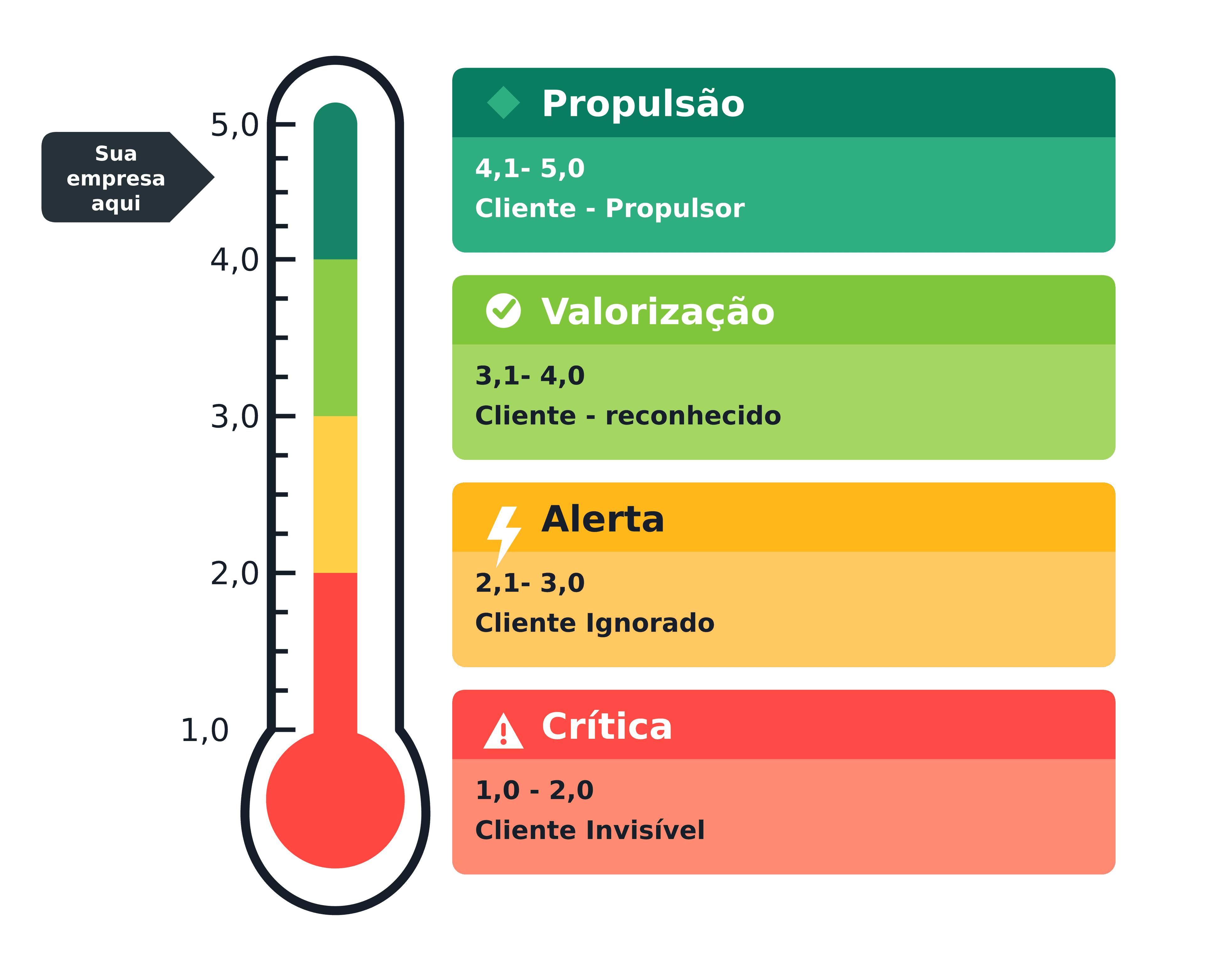
The VXS result places your customers in one of four zones. Each range corresponds to a stage of the relationship, a persona, and a strategic action.
The Customer-Promoter, the ambassador
Profile: emotionally engaged, wants to contribute. Doesn't just recommend: voluntarily sells the brand.
What they value: belonging, a leading role. Opportunity: maximum growth.
Action: celebrate, publicly recognize, and create structured community programs.
The Recognized, the customer who trusts
Profile: perceives effort and begins to trust. A solid but not exceptional relationship, with a risk of complacency.
What they value: qualified support and partnership. Opportunity: moderate growth.
Action: maintaining isn't enough. Offer co-created solutions and surprise with emotional consistency.
The Indifferent, the ignored customer
Profile: neutral, functional perception, sees no differentiation. It's the dangerous zone because it's silent.
What they value: practical benefits. Risk: low propensity to expand.
Action: symbolic gestures of attention, proactive contact, personalized recognition.
The Forgotten, the invisible customer
Profile: feels emotionally distant, reports being abandoned after the purchase.
What they value: closeness, personal recognition. Risk: high churn risk.
Action: don't offer a discount, offer to listen. Proactive reconnection, personal contact, and a genuine question.
Go deeper into VXS
Read the full methodology in the book or bring the Value Experience System to your company with Conquist.